Controlling spin waves through magnetic non-reciprocity
As part of the SWING targeted project within the SPIN Research Programme, researchers from several laboratories have demonstrated non-reciprocal spin-wave caustics in a YIG film. Their work, entitled “Shaping nonreciprocal caustic spin-wave beams“, was published on February 10, 2026.
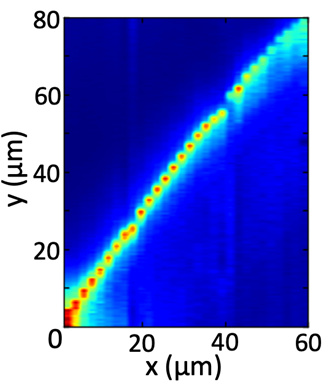
Caustics are complex near-field interference patterns that are difficult to control, and are present across a wide range of physical systems. The term “caustics” is commonly used to describe the concentration of light rays resulting from reflection or refraction within a heterogeneous system. In condensed matter, caustic effects are linked to the dispersion anisotropy of a homogeneous system, where the direction of the group velocity and that of the wave vector do not coincide. They are generally characterised by reciprocal wave propagation, meaning that waves transmitted from a source to a receiver remain the same when the source and receiver are swapped.
This work combines the inherent non-reciprocity of a magnonic system with its highly anisotropic dispersion to shape the non-reciprocal emission of caustic-type spin-wave beams in an extended yttrium iron garnet (YIG) film from a constriction in a waveguide.
A near-field diffraction model is first introduced to study the formation of spin-wave beams in homogeneous magnetic thin films, and validated through micromagnetic simulations. The model’s predictions are then confirmed, with micro-focused Brillouin light scattering revealing chiral emission of caustic spin-wave beams from the nanometric constriction of an antenna. It is shown that these non-reciprocal beams can be controlled through the polarity of the bias field, and that their direction can be precisely steered by adjusting the excitation frequency.
This work provides in-depth insights into the formation of spin-wave caustics in extended films, opening avenues for spin-wave interference-based logic or computing devices.
First author: Vincent Vlaminck
Co-authors : Dinesh Wagle, Daniel Stoeffler, Loic Temdie, Mojtaba Taghipour Kaffash, M. Benjamin Jungfleisch, Vincent Castel, Hicham Majjad, Romain Bernard, Yves Henry, Matthieu Bailleul
Plus de news Research paper