Manufacturing and observing materials down to the atomic scale with the MoxSpin project
Discover in images two figures illustrating the work of the collaborative Moxspin project, part of the 2024 ANR Call for Projects. The goal: to study a material, here barium hexaferrite, observe it at the atomic scale, and draw conclusions about the quality of the deposition carried out
The Moxspin project, part of the 2024 ANR Call for Projects, aims to explore the ultrafast dynamics of spins. Only certain materials allow for this ultrafast dynamic, and it is essential that they be of very high crystalline quality, meaning very regular in terms of atomic arrangement.
However, these materials are not commercially available: they have to be manufactured. This is why, as part of the Moxspin project, several scientists from the Institut de Physique et de Chimie des Matériaux de Strasbourg (IPCMS/CNRS/University of Strasbourg) and the Institut de Physique de Rennes (IPR/CNRS/University of Rennes) are first working to manufacture (deposit) the materials. To succeed in this deposition, the right recipe and the right parameters must be found.
To verify that the deposition was successful, the material must then be examined very closely. This is where transmission electron microscopy comes in an extremely rich technique for studying materials, allowing scientists to see and probe matter down to the atomic level. This study took place at the CEMES laboratory (CNRS), as part of the Moxspin project, funded by the SPIN Research Program.
Figure n°1: a diffraction pattern to verify the material’s structure
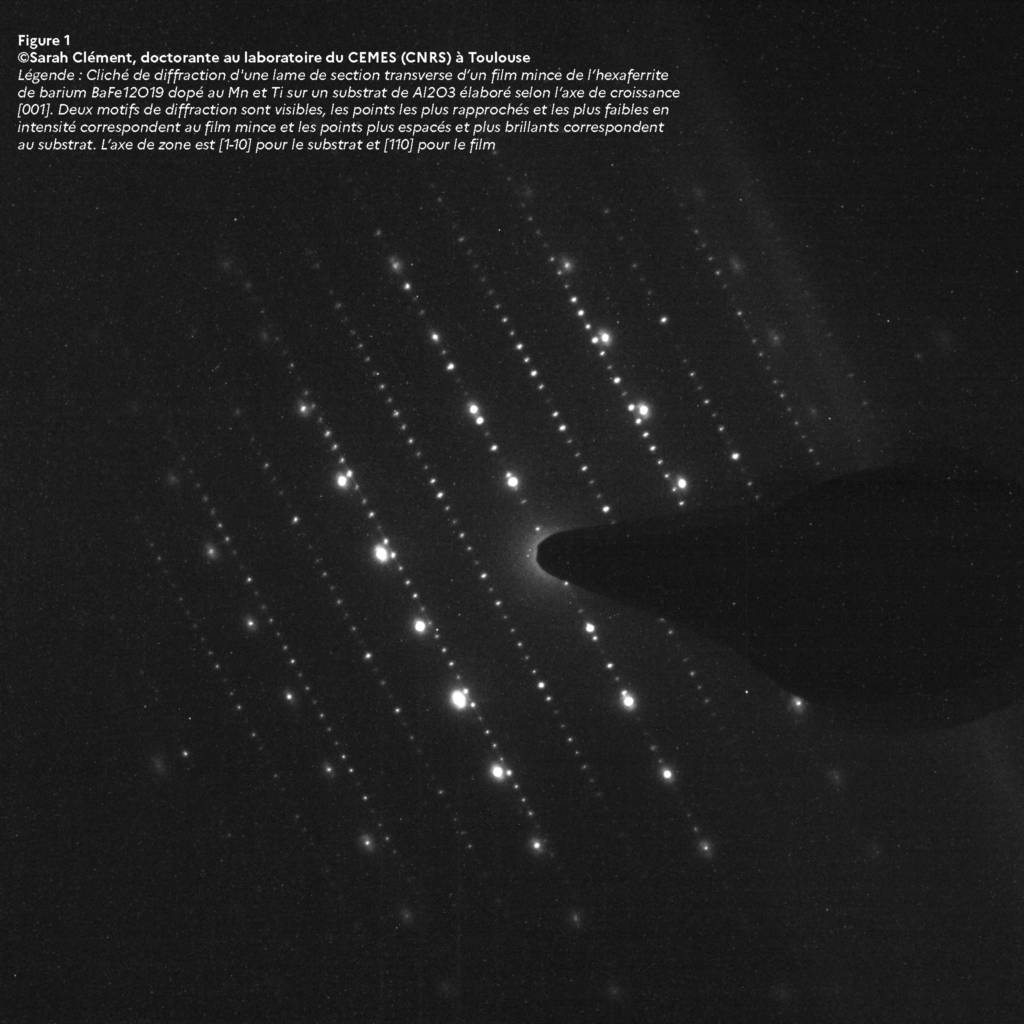
Figure 1 shows a diffraction pattern of a material of interest deposited at IPCMS. This material is an oxide called barium hexaferrite. Its basic building block contains 1 barium atom, 12 iron atoms, and 19 oxygen atoms, arranged in a somewhat complex way, but forming hexagons when viewed from above.
In the diffraction pattern, each bright spot corresponds to a type of row of atoms. In the material studied, the atoms are all well ordered, somewhat like a Rubik’s cube: a row of atoms—that is, a bright spot in the image would correspond to a row of small cubes. The shape and spacing between the spots in the diffraction pattern reveal how the atoms are organized in the material being observed (in the form of cubes? distorted cubes? hexagons?). In this case, knowing this atomic organization, or “structure,” makes it possible to determine whether the deposition was successful—that is, whether barium hexaferrite was indeed obtained with a hexagonal structure.
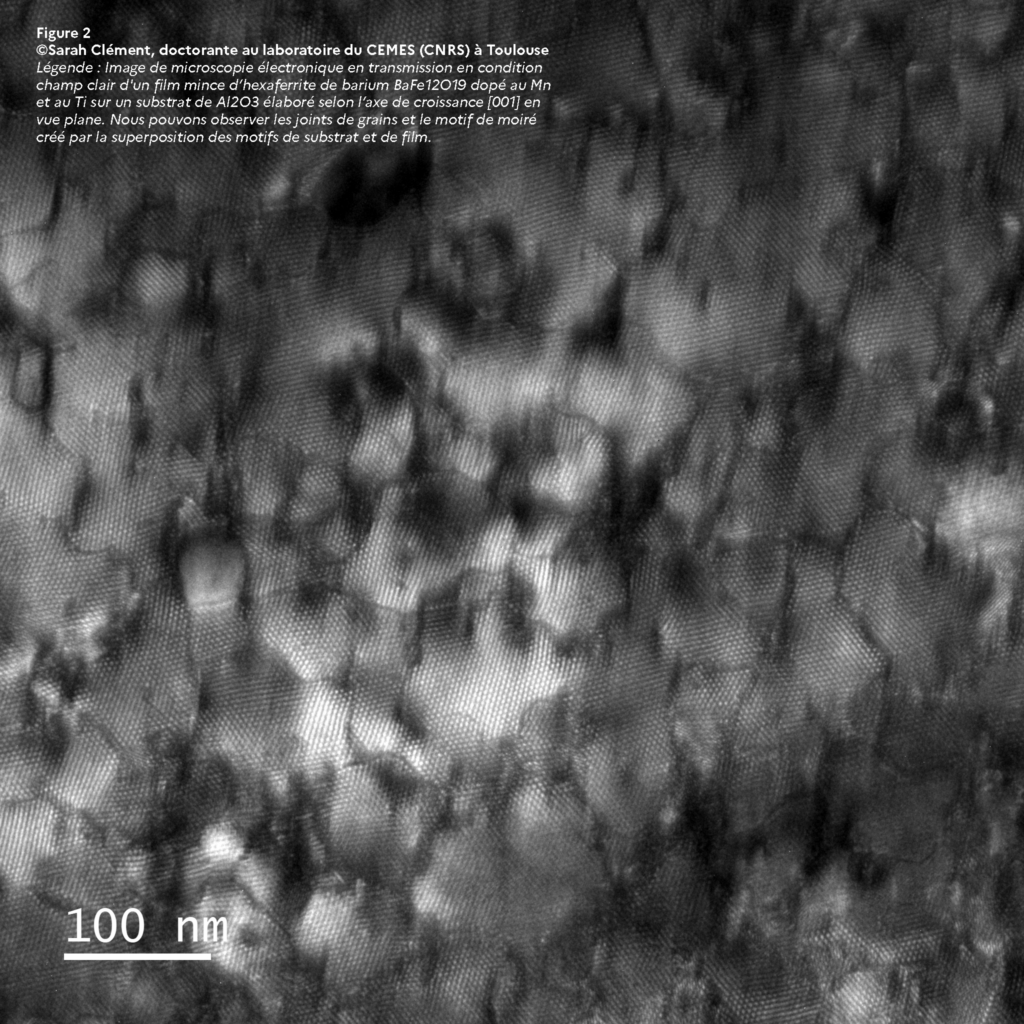
This diffraction pattern, which shows the material’s atomic structure viewed from the side, indicates that the desired material was almost entirely obtained, with good orientation and a very regular atomic arrangement. However, there are small local imperfections in the material, visible in Figure 2.
Figure n°2 : Local imperfections and a curious moiré pattern