Researchers design a transistor capable of sorting electrons by their spin
By stacking a few atomic layers of graphene and a magnetic material, scientists have designed a transistor capable of filtering electron spin with unprecedented efficiency, tunable using two simple electrical voltages. Published in “Electrical Control and High-Bias Enhancement of Magnetoresistance in van der Waals Antiferromagnetic Spin-Filter Tunnel Field-Effect Transistor” in ACS Nano on July 7, 2026, these results pave the way for faster, more energy-efficient memories, sensors, and logic circuits.
Controlling electron spin (the quantum property underlying spintronics) with the same ease as a conventional transistor controlling an electric current is a major challenge for the electronics of tomorrow. The goal is to design memories and logic circuits that are both faster and more energy-efficient.
An international team of researchers, bringing together IPCMS (CNRS/Strasbourg University), ICN2 (Catalan Institute of Nanoscience and Nanotechnologye), the Barcelona Institute of Science and Technology, ICREA, the Tsukuba Research Center for Functional Materials, l’University of Chemistry and Technology Prague, and the startup ApeironIntelligence, has just demonstrated a new type of component: a “spin-filter tunnel transistor“.
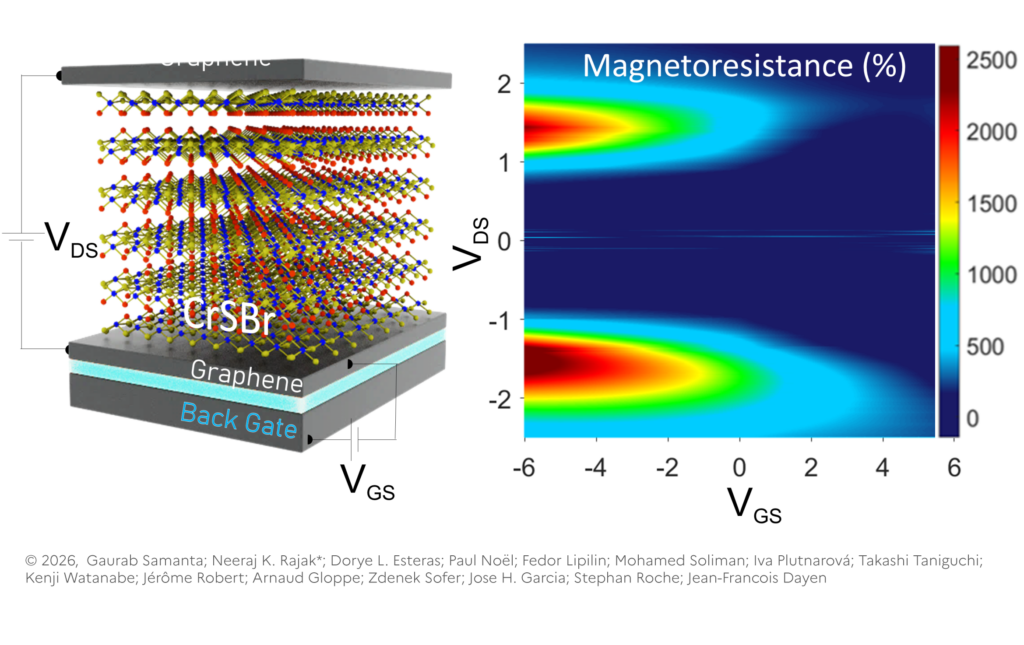
Specifically, this device is built by stacking just a few atomic layers of two-dimensional materials: two graphene electrodes sandwich a thin layer of an antiferromagnetic semiconductor, CrSBr, which acts as a spin filter. This assembly, known as a van der Waals heterostructure, makes it possible to combine, within just a few nanometers, properties that cannot be brought together in traditional materials.
The researchers show that this component has two independent electrical “levers” for adjusting spin filtering. The first is the voltage applied between the electrodes: it modifies the shape of the tunnel barrier that electrons must cross, allowing the filtering efficiency to be tuned from a few percent up to several thousand percent. The second is the gate voltage, as in a conventional transistor, which further refines this control of the spin-related signal.
The researchers verified their results in two complementary ways: on one hand, a formula describing electron tunneling matches the laboratory measurements perfectly; on the other hand, simulations based solely on the fundamental laws of physics confirm that the organization of electrons in the material corresponds exactly to what was expected.
These results pave the way for spintronic circuits that can be fully controlled by electrical voltage, where the same architecture could, depending on the applied voltages, turn into a memory, a magnetic sensor, or a logic gate. More broadly, this work illustrates the potential of 2D magnetic materials for building the next generation of fast, low-energy quantum components.
Co-authors: Gaurab SamantaNeeraj K. Rajak*Dorye L. Esteras, Paul NoëlFedor LipilinMohamed SolimanIva PlutnarováTakashi TaniguchiKenji WatanabeJérôme RobertArnaud GloppeZdenek SoferJose H. GarciaStephan RocheJean-Francois Dayen*
Plus de news Research paper