Étonnants Matériaux: fundamental research shaping tomorrow’s materials
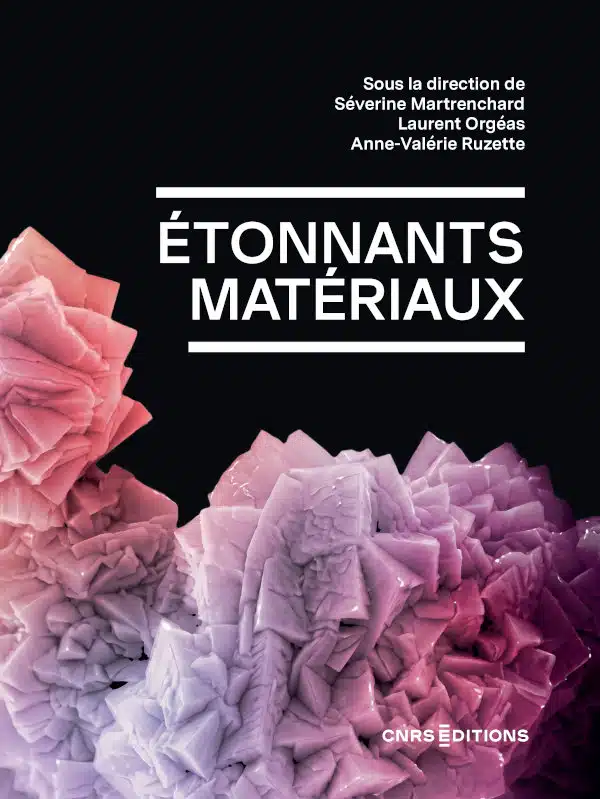
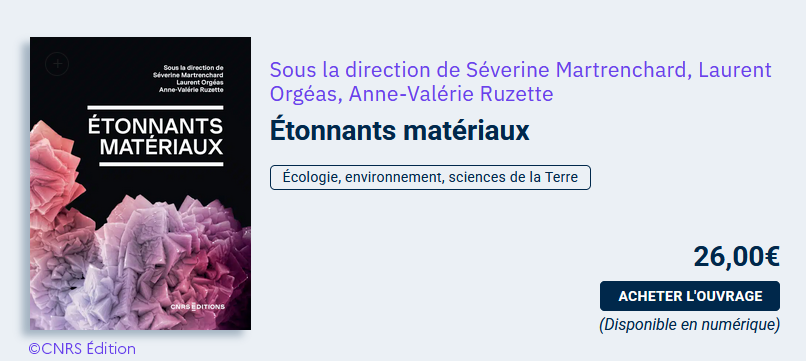
Published on September 10, 2026 by CNRS Éditions, Étonnants Matériaux (Astonishing Materials) is the latest addition to a well-established collection that already includes Étonnant Vivant, Étonnante Chimie, Étonnants Infinis et Étonnante Physique. he book invites readers to explore behind the scenes of materials science research, at the crossroads of innovation, environmental challenges, and the uses of tomorrow.
Through 67 short, accessible articles, 120 scientists from CNRS Physics, CNRS Chemistry, and CNRS Engineering laboratories explain how fundamental research on materials is shaping our future: energy, health, digital technology, the environment… The authors take readers into subjects as varied as ultralight metals, biodegradable or self-healing plastics, the nanoscale world, and the cutting-edge instruments used to explore it.
The book is edited by three researchers: Séverine Martrenchard (CNRS Physique), Laurent Orgéas (CNRS Ingénierie) et Anne-Valérie Ruzette (CNRS Chimie).
Why the materials of the future matter
Imagining the materials of the future is one of the major challenges CNRS has set for itself in addressing today’s transitions. Materials are everywhere in our daily lives, spanning a wide range of applications (chemistry, transport, construction, electronics, metallurgy) but their development has long paid little attention to environmental and energy constraints. In the face of the energy transition, it is becoming essential to develop processes that use fewer resources, less energy and water, and that move toward recyclable solutions.
This is exactly what the book demonstrates: how multiple disciplines come together to design materials that are more sustainable, resistant, recyclable, or bio-inspired, while shedding light on their uses and impacts.
Spotlight on Spintronics
Among the 67 contributions, spintronics is represented by the article “Materials for Spintronics and Oxytronics,” co-written b Manuel Bibes, researcher CNRS, and Vincent Cros, deputy director and co-director of the PEPR SPIN au Laboratoire Albert Fert.
The two authors trace the origins of the field, marked by the discovery of “giant magnetoresistance” by Albert Fert and Peter Grünberg, before turning to the key goals of materials dedicated to spintronics and the outlook for a more efficient and intelligent electronics.
A project that extends into high schools
Étonnants Matériaux also joins the educational program “Chimie et Physique étonnantes pour un Grand oral percutant!” (“Astonishing Chemistry and Physics for a Powerful Grand Oral”), born from a partnership between CNRS and the French Ministry of Education. Each chapter of the collection’s books becomes a resource for high school students, who use it to build skills in exploration, analysis, and reasoned public speaking, in preparation for the Grand Oral exam.
Learn more
📖 The book is available online from CNRS Éditions:
Plus de news scientific mediation