HERALDO, the holography technique that makes it possible to image magnetic textures in three dimensions
It is now possible to image magnetic textures of 100 nanometers, or even smaller, in three dimensions. This has been demonstrated by teams from the Albert Fert Laboratory and the SEXTANTS beamline at Synchrotron SOLEIL, in collaboration with the Helmholtz-Zentrum Berlin, the University of Augsburg, and the Max Planck Institute for Chemical Physics of Solids in Dresden, in a paper published on May 21, 2026 in Physical Review B: “Three-dimensional tomographic imaging of skyrmionic cocoons using HERALDO.”
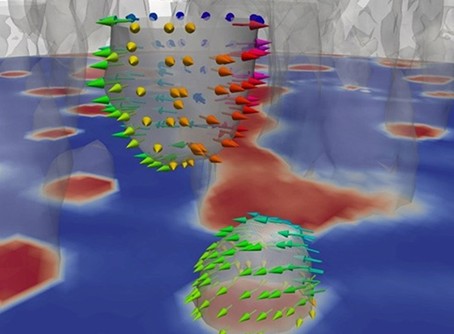
Reconstructed magnetization texture. The out-of-plane magnetization mz of the bottommost layer is represented in red (mz < 0) and blue (mz > 0). Zero mz isosurfaces appear as ghosty gray surfaces and a pair of cocoons (about 150 nm in diameter) are highlighted with the in-plane magnetization direction displayed as colored arrows.
The scientist context
Sub-micron three-dimensional magnetic textures have attracted growing interest for several years, driven by advances in imaging techniques. Some of these textures exhibit non-trivial topology: they cannot be continuously deformed into a uniform state. This property gives rise to remarkable physical effects, such as the skyrmion Hall effect or the topological Hall effect. Better understanding the chiral interactions that stabilize these textures, and being able to image their internal structure in 3D, makes it possible to control these effects.
Among the available imaging tools, techniques based on soft X-rays are particularly effective: by adjusting the photon energy, absorption becomes dependent on the magnetic state of the sample, providing magnetic contrast at high spatial resolution.
Heraldo technique
The measurements were carried out on the SEXTANTS beamline at Synchrotron SOLEIL using a coherent scattering technique, HERALDO, a holography method distinguished by its use of slits rather than holes as reference sources. This slit offers a key advantage: it allows the sample to be tilted within the X-ray beam, making it possible to record several projections of the sample and its magnetic state.
These different projections are then combined numerically using a recursive algorithm. After complex image processing, including nanometer-precision alignment, the sample’s magnetization is reconstructed in three dimension.
The study of “skyrmionic cocoons“
Using this method, the research teams studied a particular texture: the “skyrmionic cocoon.” These structures are stabilized by a precise interplay of magnetic interactions: the Dzyaloshinskii-Moriya interaction (DMI), perpendicular magnetic anisotropy (PMA), and the Zeeman energy induced by an external magnetic field. DMI and PMA rely on interfacial effects that the spintronics team at the Albert Fert Laboratory has long mastered, in Pt|Co|Al-based multilayers.
These multilayers are usually designed periodically, with regular repetitions of the same bi- or tri-layers, in order to increase the stability of the textures or the signal. Since 2020, researchers have been exploring another approach: aperiodic multilayers, which make it possible to modulate the strength of the interactions through the thickness of the stack. By reducing the anisotropy in the central part of the structure (via the cobalt thickness), they succeeded in stabilizing skyrmionic cocoons, a discretized version of torons, also known as “dipole strings.”
Confirmation through chemical selectivity
To go further, the scientists imaged two aperiodic multilayers hosting these cocoons, coupled to a periodic multilayer with stronger PMA, a configuration that potentially allows the textures to extend throughout the entire stack. By integrating a layer of NiFe alloy into the region with strong PMA, they were able to exploit the chemical selectivity of HERALDO to determine whether this central region had switched or not, thereby confirming the reliability of the 3D reconstructions obtained.
Co-authors: Jhon J. Chiliquinga-Jacome , Matthieu Grelier , Riccardo Battistelli , William Bouckaert , 1 Krishnanjana Puzhekadavil Joy , 2,3 Sophie Collin,1 Florian Godel,1 Marisel Di Pietro Martínez , 4,5 Claire Donnelly , Felix Büttner ,Horia Popescu , Vincent Cros Nicolas Reyren , and Nicolas Jaouen
Plus de news research paper
Spin waves and magnetoresistive sensors: a nanometric encounter
22 September 2025
Towards light-controlled electronic components
15 October 2025