Ultra-fast spin accumulations enable magnetization reversal in magnetic materials
Members of the SPIN Research Program and the TOAST moonshot project have demonstrated their ability to distinguish magnetization dynamics from spin accumulations in complex structures using light. Their findings were published in APS Journals on February 2, 2026, in a paper titled: “Ultrafast Spin Accumulations Drive Magnetization Reversal in Multilayers”
The research:
Imagine being able to reverse the magnetization of a material in record time, without direct contact, simply using a light pulse. This is precisely what recent research on multilayer magnetic structures has shown, where spin dynamics play a key role.
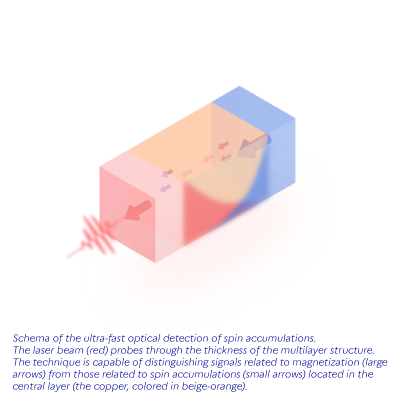
Scientists from the SPIN Research Program and the TOAST moonshot project studied systems composed of two magnetic layers separated by a thin copper layer. Using ultra-short laser pulses, they were able to both excite these structures and track their evolution on femtosecond timescales.
Previous work, published in 2023, had already demonstrated that ultra-fast laser-induced heating could reverse the magnetization of one of the layers in less than 1,000 femtoseconds. In this new study, the researchers reveal a complementary mechanism: the heating and subsequent cooling of the magnetic layers generate spin accumulations in the copper.
These accumulations are not mere side effects. They interact with neighboring magnetic layers and contribute to the magnetization reversal process. In other words, they actively participate in the dynamics that enable control over the magnetic state of the system.
To achieve these results, the researchers developed an innovative optical method capable of distinguishing magnetization dynamics from spin accumulations in these complex structures.
This breakthrough not only enhances our understanding of the underlying mechanisms but also paves the way for devices capable of manipulating information at speeds far exceeding current technologies.