SPIN-ANALYTICS: A cutting-edge Electron Spin Resonance platform inaugurated at CEA Grenoble
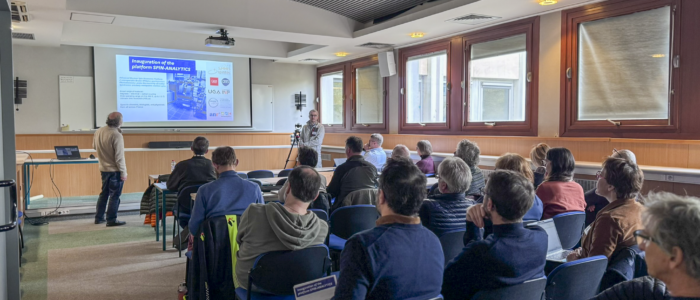
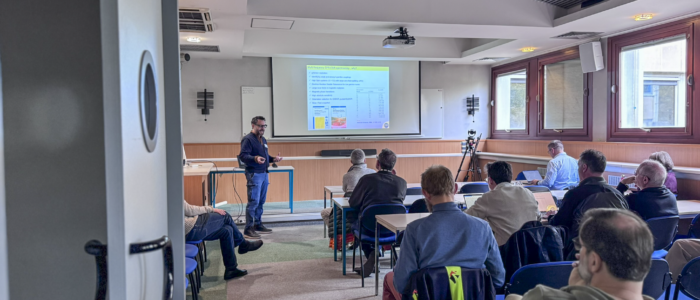
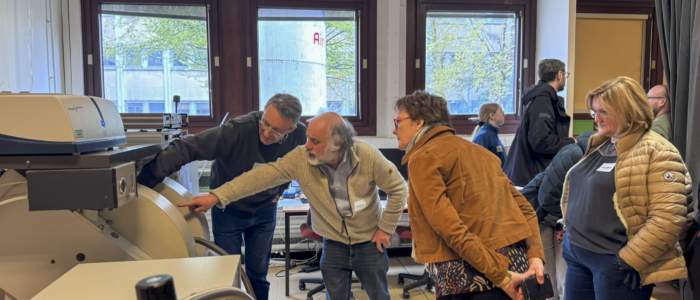
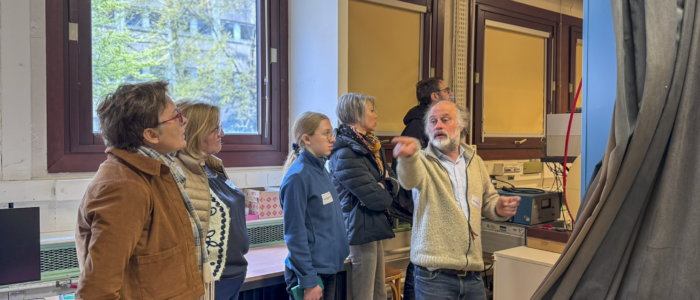
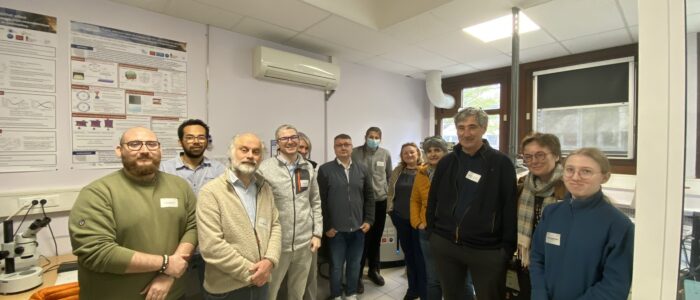
On the morning of March 30, 2026, the SPIN-ANALYTICS platform was officially inaugurated at CEA Grenoble, bringing together nearly fifty participants for scientific presentations at the interface of chemistry and physics.
Advanced Electron Spin Resonance (ESR) techniques are increasingly used to probe the reactivity of matter or precisely manipulate electron spins. For over 15 years, the Grenoble-based laboratories SyMMES and SPINTEC have collaborated in this field.
Building on their shared expertise, they have joined forces to create SPIN-ANALYTICS, a next-generation platform featuring interoperable spectrometers. Supported by the national programs PEPR LUMA, PEPR SPIN, and the research infrastructure INFRANALYTICS, the platform is open to a broad scientific community, including chemists, physicists, and biologists.
A morning of presentations at the chemistry-physics interface:
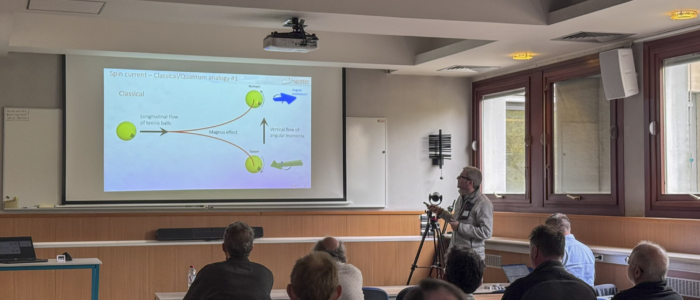
The inauguration morning featured several presentations showcasing the diversity of research topics in spintronics. The event began with an introduction by Vincent [Last Name], a CNRS researcher at SPINTEC, and Serge [Last Name], a CEA researcher at SyMMES.
These presentations explored various research avenues:
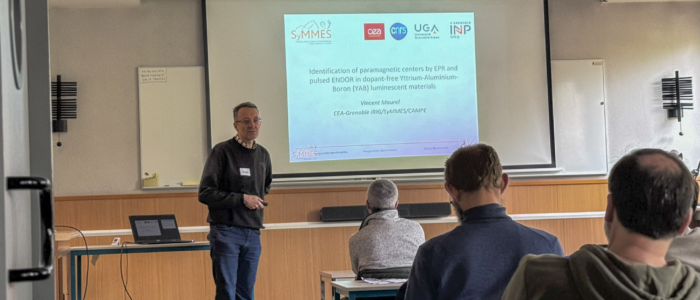
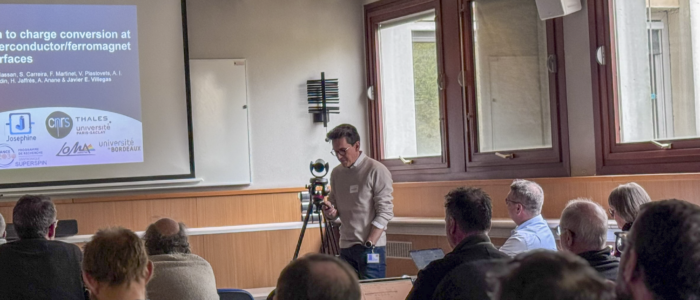
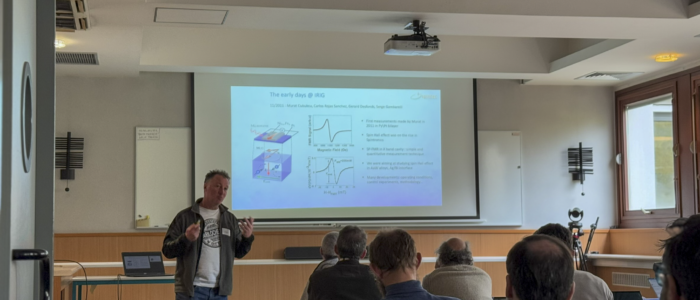
Giuseppe SICOLI (LASIRE) – Electronic spins untangling structures and reactivity of nucleic acids: a multi-frequency approach Vincent Maurel (SyMMES) – Identification of paramagnetic centers by pulsed EPR and ENDOR in luminescent YAB materials Serge Gambarelli (SyMMES) – Assessing the Robustness of the Clock Transition in a Mononuclear S = 1 Ni(II) Complex Spin Qubit by pulsed EPR Vincent Baltz (SPINTEC) – SPIN-ANALYTICS for spintronics Javier Villegas (Laboratoire Albert Fert) – Spin to charge conversion at superconductor/ferromagnetic interfaces Laurent Vila (Nellow) – Electrostatic control of the inverse Edelstein effect probed by spin pumping ferromagnetic resonnance
Applications of the SPIN-ANALYTICS Platform:
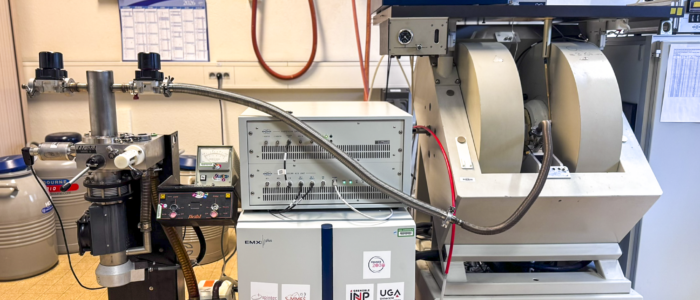
The SPIN-ANALYTICS platform is built around two Bruker EMXplus spectrometers, complemented by a Rapid Scan (RS) accessory, enabling a wide range of scientific applications.
The first system, based on an X-band spectrometer (9.6 GHz) paired with a 0–1.5 T magnet, allows measurements between 4 K and 300 K. Equipped with a variable polar angle, a loop-gap resonator, and an electrical measurement system with voltage application, it is particularly suited for spin-pumping experiments. These experiments, combining magnetic resonance and spin-charge conversion, enable the study of numerous materials in spintronics, including antiferromagnets, altermagnets, topological insulators, superconductors, semiconductors, and complex interfaces, such as Rashba-type systems.
The second system, also operating in the X-band (9.6 GHz) with a 0–1.5 T magnet and a temperature range of 4 K to 300 K, is equipped with the Rapid Scan accessory. It offers a temporal resolution on the order of 100 µs and can be coupled with incoherent light sources or pulsed lasers (e.g., a nanosecond YAG laser paired with an OPO). This setup is particularly well-suited for studying photosensitive systems, including artificial photosynthesis, photovoltaics, and photocatalysis.
Funding Sources:
> PEPR SPIN (270 k€) > Grenoble INP et UGA (150 k€) > PEPR LUMA via INFRANALYTICS (100 k€) > Projet ANR « MATHEEIAS » (80 k€)