CNRS 2026 medals: Aurore Finco, CNRS Research Scientist at the Charles Coulomb Laboratory, awarded the bronze medal
Other articles
Aurore Finco, a 2026 CNRS Bronze Medal laureate and CNRS research scientist at the Charles Coulomb Laboratory (CNRS/University of Montpellier), is recognized for her pioneering work in quantum sensor microscopy. Her research focuses on mapping magnetic fields at the nanoscale in complex materials, far beyond the simplicity of uniform magnets.In an interview for the SPIN Research Program, she reflects on her career, her research within the framework of the PEPR projects, and the future directions of her work.
Her journey as a physicist
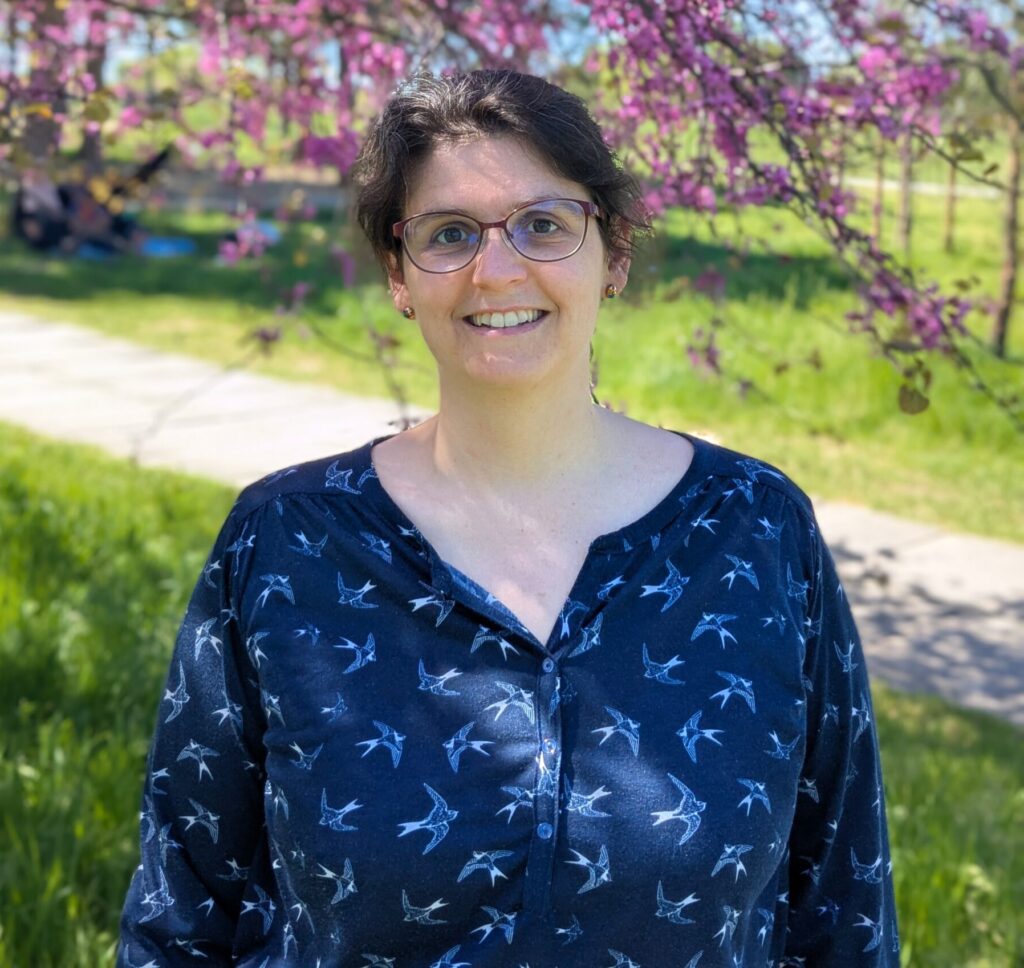
Aurore discovered her passion for science during high school. After earning a scientific baccalaureate, she joined a preparatory class in Paris before being admitted to the École normale supérieure (ENS) in Ulm.
Her fascination with magnetism began during an internship at EPFL (Lausanne), where she first encountered skyrmions—swirling magnetic quasiparticles. She then had the opportunity to join Prof. Roland Wiesendanger’s group in Hamburg for her PhD, focusing on experimental imaging techniques. Four years of research in Germany allowed her to master spin-polarized scanning tunneling microscopy, a key method for observing these magnetic textures.
Upon returning to France, Aurore continued her research in Montpellier, specializing in NV (Nitrogen-Vacancy) center microscopy—an ultra-sensitive technique for studying magnetic fields at the nanoscale. In 2021, she secured a permanent position as a CNRS research scientist.
Her research within the PEPR projects
Aurore is currently involved in several projects within the SPIN Research Program:
1. SPINCHARAC : transversal project of PEPR
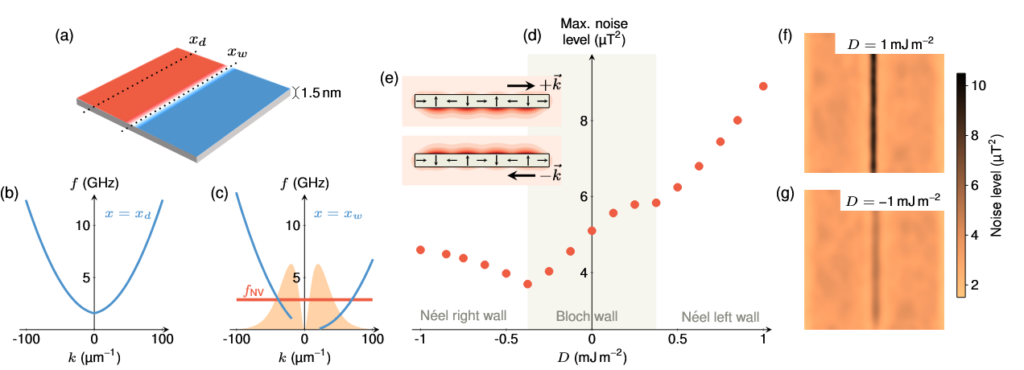
Aurore is involved in the cross-cutting project SPINCHARAC, which aims to provide state-of-the-art infrastructure and instruments for advanced characterization techniques. In this project, she uses NV microscopy to study the properties of magnetic materials. “We use the NV center not only to measure static magnetic fields but also oscillating fields produced by spin waves. This could help us better understand their propagation and interaction with matter.”
2. Alterospin : collaborative project funded by the 2024 ANR call for proposals
As part of the ALTEROSPIN project, funded by the 2024 ANR call for proposals, Aurore is investigating altermagnets, a novel class of antiferromagnetic materials with unique properties: “These materials combine the transport response of ferromagnets with the stability and speed of antiferromagnets. Studying them could pave the way for more efficient and energy-saving electronic devices.”
To image these materials, her team employs scanning NV microscopy, a technique she describes with enthusiasm: “Our microscope uses a diamond tip containing an NV defect—a nitrogen atom paired with a vacancy in the crystal lattice. This defect, sensitive to magnetic fields, allows us to map antiferromagnetic domains with a resolution of just a few tens of nanometers.”
The challenges are significant, particularly when studying these materials at low temperatures. Aurore collaborates with the Laboratoire Albert Fert (CNRS/THALES/Université Paris-Saclay) and CINaM (CNRS/Université Aix-Marseille) to synthesize samples such as bismuth ferrite or Mn₅Si₃, an altermagnet established through research at SPINTEC (CNRS/CEA/Université Grenoble Alpes). However, low-temperature measurements remain complex.
Aurore’s research extends beyond altermagnets. She is also developing protocols to enhance the sensitivity of NV microscopy, aiming to detect even weaker magnetic fields.
Another aspect of her work focuses on spin waves, whose control could revolutionize information technologies.
A point of pride: training the next generation
While Aurore is honored by the CNRS medal, what makes her most proud is mentoring her students: “Seeing my former students thrive in their careers: whether in industry or research—is incredibly rewarding. Their success is the best measure of the quality of the training they received here.”
Her last paper:
Co-écrit avec Aurore Finco, Pawan Kumar, Van Tuong Pham, Joseba Urrestarazu-Larrañaga, Rodrigo Guedas Garcia, Maxime Rollo, Olivier Boulle, Joo-Von Kim, et Vincent Jacques, Phys. Rev. Lett. 135, 136703 (2025).